The best time to bring a dog home is when you have absolutely nothing to do and nowhere to be. After living life surrounded by other dogs, long road trips to their final destination, new food, new people, and new everything, your dog will likely not be up for too much excitement. While you may be ecstatic to bring them home, their little lives are turned upside down. It is all for good, but they don’t know that. They only know that nothing is familiar.
The first days in their new home are not a good time to throw a party, have lots of visitors or run errands all day. Instead, use the time to get to know your dog and let your dog get to know you. Most Web sites recommend setting aside three days to let the dog decompress and become adjusted. The time frame is not set in stone, but it is something to strive for.
I try to imagine how I would feel after a massive life upheaval. I can say with certainty that I would need some time to decompress. I would want to chill and not be expected to do anything. It is the same way with dogs. They need time to settle in and soak up their surroundings with no expectations. They need time just to be a dog.

When your dog first moves in, it will be overwhelmed. This can result in several behaviors ranging from fear to testing boundaries. Some dogs go somewhere to hide; others may stick to you like glue. No one can say for sure; it is different for each dog. In any case, it is safe to say that the dog will not act like its typical self.
It helps to understand dog body language, especially signs of stress. However, common sense will likely do the trick. If your dog is scared, leave them alone. If they are hiding, let them hide (as long as they are safe). If they don’t want to eat, don’t stress over it. They will eat when they are ready.
Remember this general rule: it takes three days to decompress, three weeks to start settling in and learning a routine, and three months to feel truly at home. Your dog’s personality will likely begin to shine during the three-week settling-in period. It is also when behavioral issues may start to appear. So sit back and enjoy some stress-free days with your dog. There will be plenty of time for running around later.
Day One
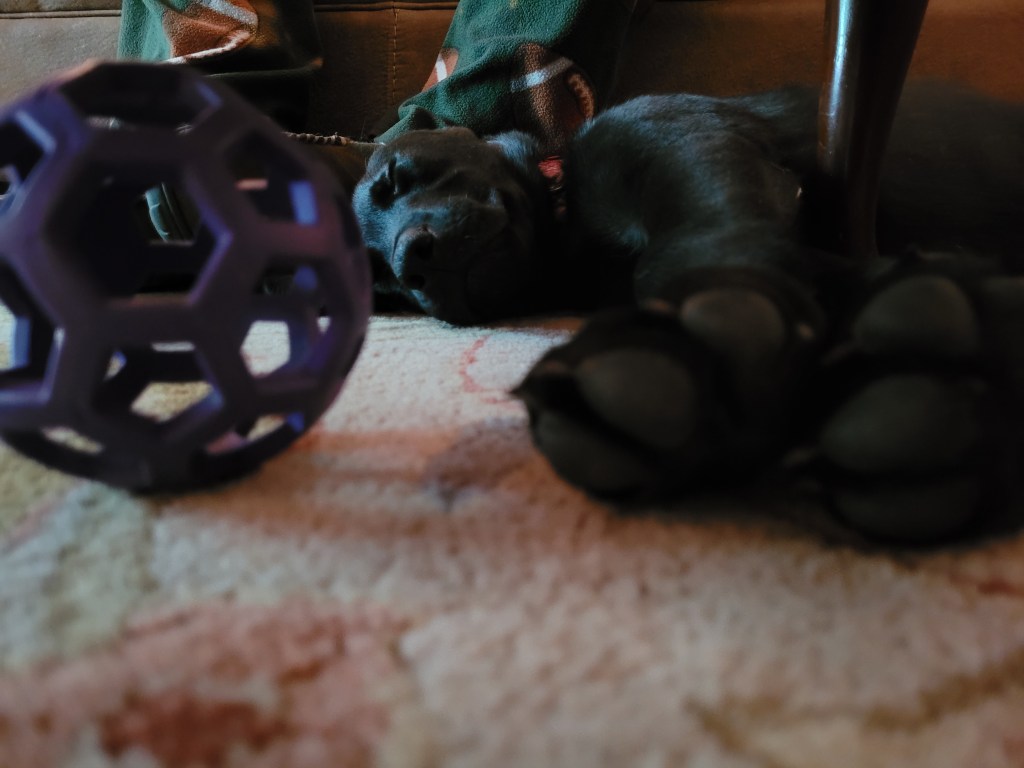
When I brought Dixie home, the first day was pretty easy. She slept. Then she slept some more. When she finished her nap, she walked around for a few minutes and then plopped on the floor and slept some more. This, of course, was sprinkled with many trips outside for her to pee and poop.
Dixie nibbled some food but did not eat much, which is what I expected. Her poop was soft and stunk so bad it could clear a room—some earmarks of an upset digestive system. Since she was transitioning cold turkey from shelter food to the kibble I bought, I wanted to ease into it. I made her some bland chicken and rice to settle her tummy. She loved the chicken and ate every piece. She hated the rice and left it all in the bowl. Oh well.
Night One
Dixie had been in crates before, so I opted to crate her at night. The little angel that slept all day made up for it by barking all night virtually non-stop. Now and then, she stopped to breathe, but it wasn’t long enough for me to get any sleep. For clarity, this dog was not stressing out over being in a crate. She did not exhibit any outward signs of stress, nor did she try to claw her way out. Nope. She just sat in the middle of the crate and barked, barked, barked.
I started with her crate in the bedroom to keep an eye on her. I did not want to acknowledge her barking in any manner (i.e., I ignored her). It did not help one bit, and the barking drove me crazy. By morning, I had pushed that crate into the living room, just outside the bedroom door.
I was in a slight predicament. I had to take her out a couple of times in the middle of the night, yet I did not want to approach and open the crate in the middle of her bark fest. I did not want her to mistake a potty break with getting attention from barking, so I waited until she was quiet for 30 seconds, and then I approached her crate, praised her for being so quiet, opened the door, and scooped her up to go outside. It was the beginning of trying to teach her that barking led nowhere, and quietness got her attention.
After each potty break, she got some loving and then went back into the crate, where she got right back to her barking business. The only thing that got me through the first night was knowing it would eventually end, and it did, just in time to get up and start Day Two.
Day Two
We had a lot of nothing on the agenda for the second day.
Dixie was more energetic than the first day but was still acting a bit lost. As the day went on, she seemed more comfortable with her surroundings. We let her romp in the snow and played basic brain games such as ‘touch’ and ‘look at me.’ Many websites recommend not asking the dog to do anything during decompression. They recommend not even approaching the dog and only interacting if the dog comes to you. I understand the logic of not tracking down your dog and making them learn to sit, but I see no harm in a basic brain game if she is engaged and wants to play.
I decided to start her feeding schedule whether she ate it or not. A meal schedule is more important than one would think. Set the mealtime and let everything else is built around it. Due to Dixie’s age, I planned on feeding her four times daily.
I gave Dixie a little more chicken and rice for breakfast. She still hated the rice and ate all the chicken. At least she was in the mood to eat. She just did not like what was being offered. I did the same for lunch, except I started to introduce kibble. She seemed to like the kibble, which did not seem to upset her system, so I continued increasing the ratio; by dinner, we had phased out the chicken and rice, she was eating just kibble and seemed to be doing well. Her poop was still soft and nasty smelling but not any worse than the day before. I knew it would take a few days to get back to normal.
Night Two
As with the first night, once I put her in her crate and closed the door, she started barking up a storm. She barked until I was ready to scream (but didn’t). On the positive side, she took a few momentary breaks lasting a few minutes each. Progress was progress.
Day Three
By day three, Dixie’s personality started to shine through. She was spunky, demanding, and sassy for sure. Come to think of it, she acted like I was her littermate. She was a herding, mouthing, nipping, clothes-ripping, demand-barking, obnoxious puppy. Her herding and nipping started to freak me out because she would chase me around the house with those razor-sharp puppy teeth. Decompression or not, that stuff was not going to fly for long.
Like the day we met her, Dixie wanted to take control of everything. She wanted what she wanted whenever she wanted it. If she did not get her way, she would demand bark, and boy, was she loud! She was into everything and would bark bark bark if we redirected her.
Night Three
Rinse and repeat—bark and bark with a few more quiet periods than the night before. That was the end of our decompression period. Dixie was clearly feeling right at home.
Day Four Onward
By the end of day four, I was the owner of a brand-new dog pen. I needed to shrink Dixie’s world, control her access to the house, and, admittedly, help me keep my sanity.
Day three was the start of the very long road of trying to train a dog that thinks they are in charge. Quite stubborn, I must say. It has been a year, and we are still working on it. She was and is quite a handful.
 Dixie the Pony Dog
Leave a comment